
The Repricing of Value: Navigating the Emergence of the Augmented Executive Search Firm
Dr. Ayesha Khanna on “The Augmented Search Firm”
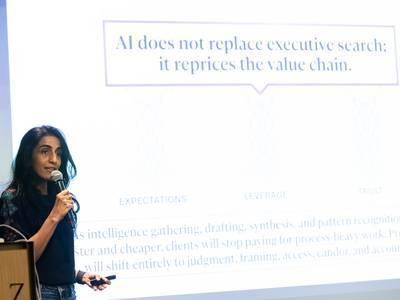
On the final day of the 2026 Kestria Global Conference in Singapore, attention shifted to one of the most disruptive forces in professional services: Generative Artificial Intelligence. Dr. Ayesha Khanna, a technology specialist and strategic advisor, led an AI Ambassador session titled The Augmented Search Firm: How AI Is Reshaping Client Expectations, Consultant Leverage, and Trust.
Dr. Khanna’s briefing identified an important development: AI adoption in professional services has reached a notable threshold, increasing from 22% to 40% in 2026, with more than 80% of users engaging with these tools on a weekly basis. She argued that firms must move beyond basic software integration and instead reconsider the value structures of their organisations. Rather than replacing human professionals, AI is repricing the professional services value chain. The following analysis, informed by her session and documented in the Kestria Global Insights report, outlines how premium boutique executive search firms can adapt to this changing environment.
The Executive Search Paradox: Reconsidering “Search Theatre”
For several decades, traditional executive search firms have justified premium fees through the volume of process activities they perform, a practice referred to as “Search Theatre”. This term describes visible, labour-intensive tasks such as broad market scans, generic client briefs, dashboard preparation, and the creation of extensive candidate longlists. While these activities appear thorough, they do not necessarily improve the quality of a client’s final hiring decision.
In 2026, AI is rapidly automating these operational elements. As machine intelligence performs market mapping, candidate identification, information synthesis, and drafting of communications, the cost of these activities is decreasing significantly. As a result, client willingness to pay premium fees for repeatable manual processes has fallen.
This has produced a notable paradox in client behaviour. Corporate buyers are encouraging external firms to adopt AI for efficiency, yet fewer than 20% formally require it in requests for proposals because they are uncertain about how to govern it. Clients want faster service but expect the relationship to retain a human character. They also expect lower fees for routine work while remaining willing to pay premium rates where human judgement is required.
The principal risk for the executive search industry is therefore not that AI will make consultants redundant. The greater risk is that clients will stop paying premium fees to firms with an unclear value proposition that continues to charge for effort rather than outcomes.
Unbundling the Search Process: The AI Efficiency Zone and the Human Premium Zone
To respond to this shift, premium boutique firms must reconsider their fee structures and view their work through an unbundled service model. The activities subject to downward pricing pressure (the AI Efficiency Zone) can be distinguished from those that retain premium value (the Human Premium Zone).
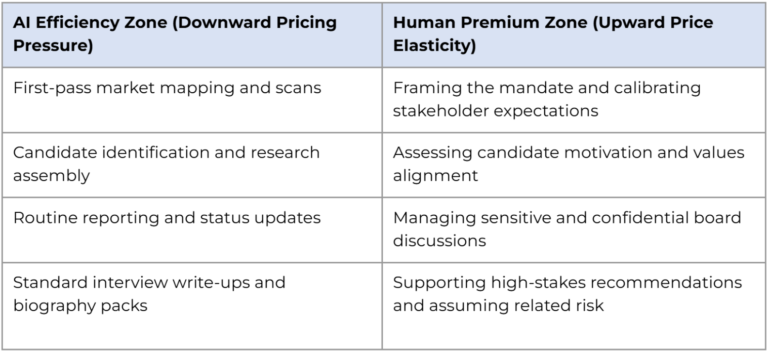
The central conclusion drawn from this framework is that executive search is evolving away from process execution and toward strategic interpretation, contextual assessment, and trust brokerage. The value proposition has shifted from identifying candidates to determining which candidate is appropriate, explaining cultural fit, and articulating leadership trade-offs and risks.
The Strategic Boutique Model: Agility as a Competitive Advantage
While large multinational recruitment firms face structural challenges when attempting to revise legacy operating models, small and mid-sized boutique firms hold several advantages in a machine-augmented market.
The first advantage is agility. A boutique firm of around 20 staff can restructure internal workflows, train its team consistently, and integrate AI into core operations within a single quarter.
The second advantage relates to the shift from longlists to verified shortlists. Clients increasingly value validated quality over quantity. Boutique firms are well positioned to deliver a verified shortlist in which each candidate is assessed for leadership style, motivation, and strategic fit, thereby reducing hiring risk.
A third advantage is direct senior partner involvement. In contrast to larger firms, where senior partners often lead client pitches but delegate execution to junior teams, boutiques are able to ensure that the consultant presenting the engagement also conducts the search, supporting continuous accountability.
The fourth advantage is governed transparency. As machine-generated data becomes more common, clients are increasingly cautious about overly polished AI outputs. Boutique firms can gain market share by publishing clear positions on AI governance, including where AI is used, where its use is limited, and how candidate data privacy, such as compliance with the General Data Protection Regulation (GDPR), is maintained.
Conclusion
The selection of a chief executive officer or board member remains a high-stakes decision based on trust, and it is unlikely to be fully delegated to an algorithm. Technology can effectively support the identification of talent, while human insight, judgement, and discretion continue to represent the primary sources of value in executive search.
Dr. Ayesha Khanna on “The Augmented Search Firm”
On the final day of the 2026 Kestria Global Conference in Singapore, attention shifted to one of the most disruptive forces in professional services: Generative Artificial Intelligence. Dr. Ayesha Khanna, a technology specialist and strategic advisor, led an AI Ambassador session titled The Augmented Search Firm: How AI Is Reshaping Client Expectations, Consultant Leverage, and Trust.
Dr. Khanna’s briefing identified an important development: AI adoption in professional services has reached a notable threshold, increasing from 22% to 40% in 2026, with more than 80% of users engaging with these tools on a weekly basis. She argued that firms must move beyond basic software integration and instead reconsider the value structures of their organisations. Rather than replacing human professionals, AI is repricing the professional services value chain. The following analysis, informed by her session and documented in the Kestria Global Insights report, outlines how premium boutique executive search firms can adapt to this changing environment.
The Executive Search Paradox: Reconsidering “Search Theatre”
For several decades, traditional executive search firms have justified premium fees through the volume of process activities they perform, a practice referred to as “Search Theatre”. This term describes visible, labour-intensive tasks such as broad market scans, generic client briefs, dashboard preparation, and the creation of extensive candidate longlists. While these activities appear thorough, they do not necessarily improve the quality of a client’s final hiring decision.
In 2026, AI is rapidly automating these operational elements. As machine intelligence performs market mapping, candidate identification, information synthesis, and drafting of communications, the cost of these activities is decreasing significantly. As a result, client willingness to pay premium fees for repeatable manual processes has fallen.
This has produced a notable paradox in client behaviour. Corporate buyers are encouraging external firms to adopt AI for efficiency, yet fewer than 20% formally require it in requests for proposals because they are uncertain about how to govern it. Clients want faster service but expect the relationship to retain a human character. They also expect lower fees for routine work while remaining willing to pay premium rates where human judgement is required.
The principal risk for the executive search industry is therefore not that AI will make consultants redundant. The greater risk is that clients will stop paying premium fees to firms with an unclear value proposition that continues to charge for effort rather than outcomes.
Unbundling the Search Process: The AI Efficiency Zone and the Human Premium Zone
To respond to this shift, premium boutique firms must reconsider their fee structures and view their work through an unbundled service model. The activities subject to downward pricing pressure (the AI Efficiency Zone) can be distinguished from those that retain premium value (the Human Premium Zone).
The central conclusion drawn from this framework is that executive search is evolving away from process execution and toward strategic interpretation, contextual assessment, and trust brokerage. The value proposition has shifted from identifying candidates to determining which candidate is appropriate, explaining cultural fit, and articulating leadership trade-offs and risks.
The Strategic Boutique Model: Agility as a Competitive Advantage
While large multinational recruitment firms face structural challenges when attempting to revise legacy operating models, small and mid-sized boutique firms hold several advantages in a machine-augmented market.
The first advantage is agility. A boutique firm of around 20 staff can restructure internal workflows, train its team consistently, and integrate AI into core operations within a single quarter.
The second advantage relates to the shift from longlists to verified shortlists. Clients increasingly value validated quality over quantity. Boutique firms are well positioned to deliver a verified shortlist in which each candidate is assessed for leadership style, motivation, and strategic fit, thereby reducing hiring risk.
A third advantage is direct senior partner involvement. In contrast to larger firms, where senior partners often lead client pitches but delegate execution to junior teams, boutiques are able to ensure that the consultant presenting the engagement also conducts the search, supporting continuous accountability.
The fourth advantage is governed transparency. As machine-generated data becomes more common, clients are increasingly cautious about overly polished AI outputs. Boutique firms can gain market share by publishing clear positions on AI governance, including where AI is used, where its use is limited, and how candidate data privacy, such as compliance with the General Data Protection Regulation (GDPR), is maintained.
Conclusion
The selection of a chief executive officer or board member remains a high-stakes decision based on trust, and it is unlikely to be fully delegated to an algorithm. Technology can effectively support the identification of talent, while human insight, judgement, and discretion continue to represent the primary sources of value in executive search.