
Women Have the Seats. Now They Need the Voice, Says 30% Club Malaysia
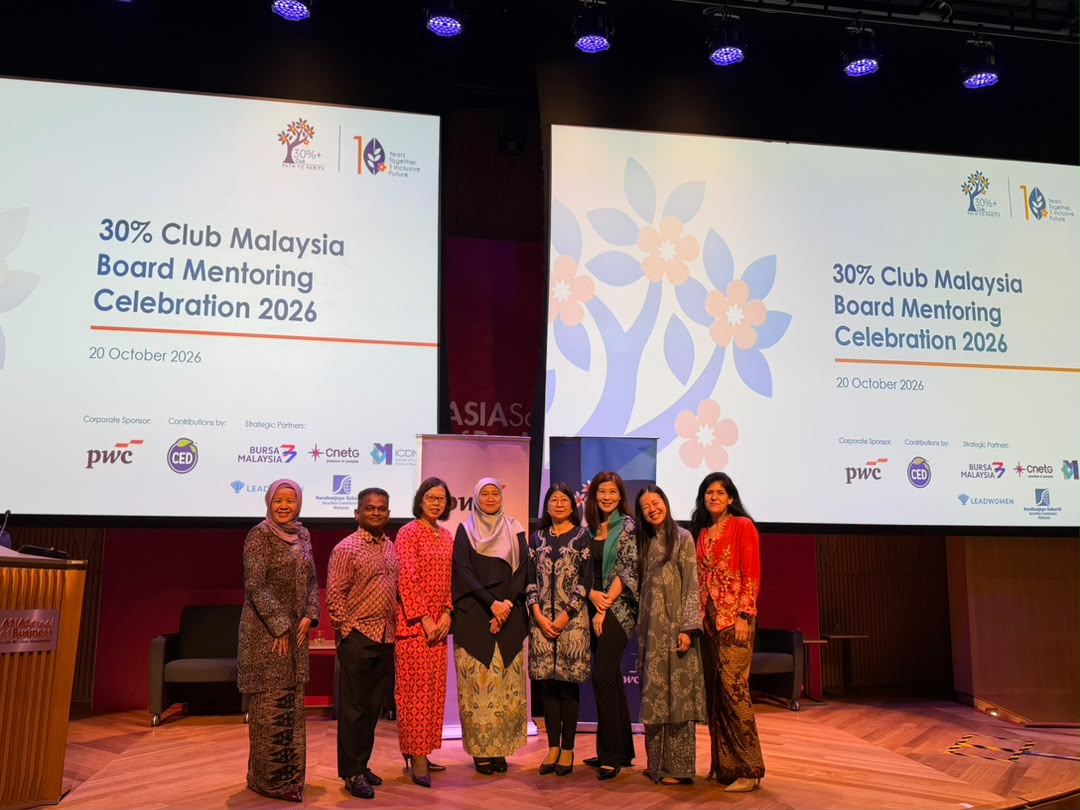
Malaysia’s boardrooms have passed a milestone. Women now hold 34.4% of board seats at the country’s top 100 public-listed companies (PLCs), according to the Securities Commission Malaysia (as of1 April 2026). That is above the 30% target the 30% Club has championed. Leaders in the field are now asking whether those seats carry real influence.
Itis a question that matters to CnetG Asia and Malaysia, a key strategic partner of the 30% Club Malaysia, as it works with the club to advance gender-balanced leadership in the country’s corporate sector.
From representation to real influence
That question set the tone for the 30% Club Malaysia’s annual Board Mentoring Celebration 2026,themed “Beyond the Numbers: From Representation to Real Influence.” The event was held at the Khazanah Auditorium at the Asia School of Business in Kuala Lumpur.
Club chair and PwC Malaysia executive chair Nurul A’in Abdul Latif said Malaysia has no shortage of capable women leaders. In her view, what many aspiring directors lack is access to networks, sponsorship and opportunities to gain boardroom exposure.
Steering committee member and PwC Malaysia partner Pauline Ho put it plainly: the real measure of success is whether women’s perspectives are heard, valued and reflected in decisions, notjust whetherthey hold a seat. She added that diverse boards are better equipped to handle complexity, challenge assumptions and drive long-term value.
The broader market still lags
The headline figure comes with a caveat. Across all PLCs onBursa Malaysia, women hold 29.8% of board seats. Progress among the largest companies has not yet been matched across the wider market, so there is still work to do beyond the top 100.
The Board Mentoring Scheme
The event celebrated 15 women who completed the 11th cohort oftheBoard Mentoring Scheme (BMS) and welcomed 24 participants to the 12th. Launched in 2017 with PwC Malaysia,the nine-month programme pairs aspiring women directors with experienced board members to build governance knowledge, professional networks and readiness for appointments.
The results so far:
● More than 179 senior women leaders supported across 11 cohorts
● 47% of mentees have secured board roles in PLCs, SMEs and industry associations
● Others continue to lead and influence from executive positions
“Would You Hire Her?”
The most talked about session was an interactive boardroom exercise. Participants acted as a nomination committee and assessed gender blind CVs, then reflected on how quickly assumptions form. The exercise looked at how gender, career breaks, age and non-traditional career paths can shape judgements about leadership candidates.
Allyship: turning intention into action
A keynote by Tan Sri Shahril Ridza Ridzuan, chairman of Axiata Group, stressed thatleaders must build cultures where diverse perspectives are actively sought and turned into outcomes. He then joined a paneltitled “The Power of Voice, Influence and Allyship” with:
● Ganesh KumarBangah, chairman, Malaysia Digital Economy Corporation
● Teoh Su Yin, independent non-executive director and nomination committee chair, TIME dotCom
● Hisham Zainal Mokhtar, nomination and remuneration committee chair, Telekom Malaysia
The panel discussed challenging unconscious bias, widening talent pipelines and creating more equitable routes to leadership. A recurring point was that decisions on recruitment, promotion, succession and board appointments are often made by people already in positions ofinfluence. That makes male allies essential: opening doors, sponsoring talent and questioning traditional ideas of “board readiness.”
The panel’s practical advice for aspiring directors:
● Time commitment:Board service demands real, sustained availability.
● Diversity of experience: Exposure across industries broadens perspective.
● Relevant, specific skills:Boards need expertise such as digital transformation, so know which gap you fill.
Recognising male allies
The event also put the spotlight on Men Allies for Parity, launched in 2025 forthe 30% Club Malaysia’s 10th anniversary. Itrecognises men who sponsor emerging leaders, challenge conventional definitions of board readiness and advocate inclusive decision-making. Nominations are open, and the club plans to launch RecognitionBadges for corporate websites and LinkedIn profiles.
CnetG Asia and Malaysia: a strategic partner in the journey
As a key strategic partner of the 30% Club Malaysia, CnetG Asia and Malaysia shares the club’s beliefthat boardroom diversity must be measured by influence, not headcount. Partnerships like this help turn the club’s goals into practice: widening the pipeline of board-ready women, encouraging sponsorship and promoting more inclusive leadership across Malaysian business.
What it means for business
For corporate Malaysia,the message is thatthe 30% target was neverthe end goal. In the club’s words, itis the floorto build on. The next stage depends on:
1. Sponsorship, not just mentorship, so capable women gain visibility and exposure
2. Fair, bias-aware appointment processes in nomination committees
3. Extending progress beyond the top 100 to the wider market, where representation is below 30%
4. Inclusive board cultures where every director’s view shapes strategy and governance
5. Strong partnerships between organisations such as cnetG Asia and Malaysia and the 30% Club Malaysia to sustain momentum
The 30% Club Malaysia, launched in May 2015 as part of a global business-led campaign for gender parity on boards and in the C-suite, says its focus remains on making sure diversity translates into meaningful influence in governance, strategy and long-term performance.
The club’s closing question to leaders is worth asking in every boardroom: who is the leader you will sponsor next?
Conclusion
The 30% Club Malaysia was launched in May 2015 as part of a global, business-led campaign for gender parity on boards and in senior management. Its currentfocus is to ensure that diversity leads to real influence in governance, strategy and long-term performance. The club ends with a question for all leaders: who is the leader you will sponsor next?